The Kohinoor’s disappearance
The Secret of ChimneysThe Kohinoor’s disappearance is an old royal secret whose concealment reaches into the present-day political and criminal plot. During a visit to England by King Nicholas IV and Queen Varaga, the jewel disappeared; the authorities suppressed the affair, and the Queen left England without it. Its unknown hiding place turns Chimneys into a possible repository of both a missing treasure and a dangerous history, while Count Stylptitch’s memoirs raise the possibility that the secret will finally be exposed.
The royal theft and its concealment
The background to the disappearance lies in the visit of King Nicholas IV and Queen Varaga to England, where they were guests of the late Marquis of Caterham, then Secretary of State for Foreign Affairs. Superintendent Battle later explains that Queen Varaga was both a royal guest and, in his account, an expert thief. The substitution made during the theft was so convincing that only an expert could have recognized it. Battle considers King Victor the likely maker of the substitute and the likely author of the larger plan, whose daring and scale pointed toward him.
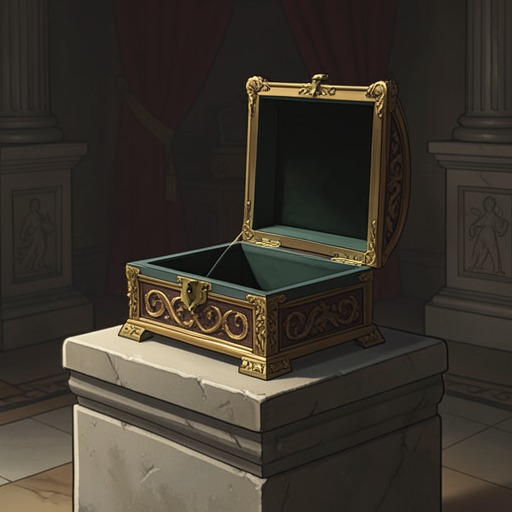
The discovery was never made public. The authorities, Battle says, handled the matter quietly, and their efforts did not establish where the Queen had hidden the real jewel. One fact is certain: the diamond did not leave England with Queen Varaga. Battle suspects it may still be concealed in the council chamber at Chimneys, but presents this as a possibility rather than a recovered fact. The secrecy that protected the incident also preserved its central uncertainty: the jewel’s location remained unknown, and the public account gave no explanation of its disappearance.
The jewel re-enters the present plot
Years later, the unresolved theft offers a possible motive for a new crime. Battle recalls that Chimneys was one of four places where the royal visitor might have concealed the stone. King Victor was arrested in Paris three days after the disappearance, and the authorities hoped he might eventually lead them to the jewel. Although Chimneys had been searched and overhauled repeatedly, Battle argues that searches are of limited use when investigators do not know where to look.
That reasoning produces a suspicion about Prince Michael’s murder: King Victor might have come to Chimneys to search for the diamond, been surprised by Prince Michael, and shot him. Battle raises this as a possibility, not as an established account of the killing. The jewel’s disappearance thus gives the investigators one potential explanation for the murder, but the evidence in this line of inquiry remains conditional. The old theft connects a concealed object to a new death without, by itself, proving who was responsible.
The political stakes surrounding the memoirs intensify the danger of reopening the past. George Lomax explains that their publication could ruin the plan to restore the monarchy in Herzoslovakia, where supporters intend to offer the crown to Prince Michael with the support of the British government. In return for a loan of roughly a million, Michael is prepared to grant concessions to Isaacstein and Co. The concern is therefore not simply that an old scandal might attract readers: disclosure could disrupt a current arrangement linking restoration, government support, and finance.
The memoir clue and its interpretation
When Battle wonders whether the memoirs could contain a clue to the hiding place, he initially judges that unlikely. Count Stylptitch had opposed Queen Varaga’s marriage and, Battle reasons, was not someone she would have trusted with the secret. Anthony offers a different possibility: Stylptitch might have discovered the hiding place without her knowledge. He then points to the Count’s own words as evidence that this possibility deserves attention.
A passage from Queen Varaga’s letter, rendered as a short operational memorandum, reads: "Operations carried out successfully, but S. double-crossed us. Has removed stone from hiding-place. Not in his room. I have searched. Found following memorandum which I think refers to it: "Richmond Seven Straight Eight Left Three Right."" The initial S. leads Anthony to identify Stylptitch as the person who changed the hiding place. The letter does not settle where the diamond is now, but it transforms the question: Stylptitch is no longer merely a possible observer of the secret; the evidence attributes an active change of its location to him.
The word Richmond prompts Virginia to connect the memorandum with the Holbein portrait in the council chamber. The portrait depicts the Earl of Richmond, and the searchers had been tapping at the wall just below it. Battle confirms that the painting is a starting point, not a complete solution: the figures in armour beneath it had already led the thieves to test whether the numbers referred to measurements, but that interpretation failed. They then considered a secret passage, stairway, or sliding panel. The clues narrow attention to a specific feature of the room while leaving the numbers and the diamond’s exact position unresolved in this account.
A secret bound to dynastic history
The disappearance belongs to a wider history of political rupture. Anthony recounts that Queen Varaga had been born to a Paris music-hall performer’s life and was presented as Countess Popoffsky, supposedly of Romanoff blood, before marrying King Nicholas IV and being crowned. The marriage provoked discontent in Herzoslovakia; an uprising eventually stormed the palace, killed the King and Queen, and proclaimed a republic. The jewel’s disappearance is therefore attached to a court whose contested legitimacy ended in revolution, even as later plans sought to restore the monarchy.
The succession question makes that history immediate. When Battle asks who follows Prince Michael, Lomax says that Prince Nicholas is, in all probability, the next heir; Battle identifies him as Prince Nicholas Obolovitch, Michael’s first cousin. He is believed to be in the United States and to have been raising money on his expectations. At the close of the book, Anthony reveals that he himself is Nicholas: he had spread the report of his death in the Congo and emerged from Africa under the name Anthony Cade. This revelation establishes the identity of the prospective heir, but it does not itself disclose the jewel’s final location. The Kohinoor remains an object of continuing uncertainty, its disappearance having carried a suppressed royal crime into the negotiations and succession struggles of the present.